Montreal's development has always been tied to its geology—the city sits on the St. Lawrence Lowlands, a sedimentary basin of Paleozoic limestone, shale, and sandstone overlain by glacial till and deep marine clay deposits in the eastern districts. This geological setting, combined with the region's moderate but real seismicity linked to the Western Quebec Seismic Zone, creates a complex site amplification picture that uniform code provisions cannot capture. A seismic microzonation study integrates field shear wave velocity measurements with geotechnical data to map how ground motion varies across a single site or an entire borough, helping engineers place critical infrastructure where shaking will be least amplified. For projects in Hochelaga-Maisonneuve or Ville-Marie, where the soil column often exceeds 30 meters of Champlain Sea clay, the surface response during even a moderate M5 event can differ sharply from rock outcrop predictions.
In the Champlain Sea clay basin, Vs30 values below 180 m/s are common, pushing sites into Site Class E and demanding rigorous ground response analysis for any structure taller than three storeys.
Service characteristics in Montreal
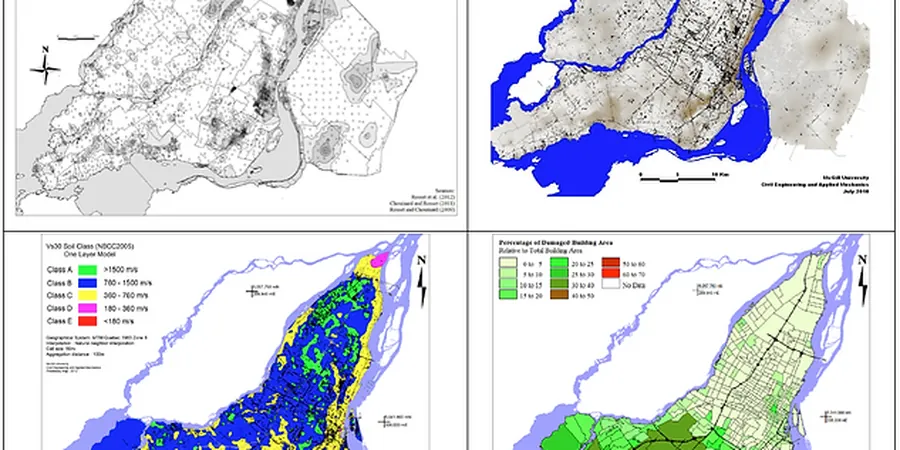
Critical ground factors in Montreal
The Champlain Sea clay that underlies much of eastern Montreal and Laval presents a sharp risk profile: its high plasticity (PI often 30-50%) and sensitivity can trigger cyclic softening during prolonged shaking, a mechanism distinct from classic liquefaction in sands. In the 2010 Val-des-Bois M5.0 earthquake, spectral accelerations at 0.2 seconds in Montreal's clay zones exceeded code-computed values by 30-40% at certain periods, a reminder that basin-edge effects and deep impedance contrasts demand more than a simple Vs30 check. Our microzonation approach identifies zones where the fundamental site period aligns with the structural period of mid-rise buildings, flagging resonance risk that standard hazard maps miss. For sites near the St. Lawrence River, we also evaluate lateral spreading potential using the Youd et al. (2001) empirical method, correlating SPT blow counts from our SPT drilling program with expected cyclic stress ratios from the design earthquake.
Our services
Our Montreal microzonation workflow is built around three core service modules that can be delivered individually or as a complete site-specific seismic hazard package. Each module aligns with the requirements of Part 4 of the NBCC 2020 and the structural design provisions of CSA A23.3.
Site Classification and Vs Profiling
Active and passive surface wave testing (MASW, MAM, ReMi) combined with downhole seismic in boreholes to determine Vs30 and the full shear wave velocity profile to bedrock. Delivers the Site Class (C, D, E, or F) required for NBCC structural design and identifies soft layers that control ground response.
1D and 2D Ground Response Analysis
Equivalent-linear analysis using DEEPSOIL or SHAKE2000, with modulus reduction and damping curves calibrated to Montreal clay (Massoudi & Gagne 2009). For complex basin geometry, we run 2D FLAC models that capture surface wave generation at the rock-soil interface, providing design spectra and acceleration time histories.
Liquefaction and Cyclic Softening Assessment
SPT- and CPT-based liquefaction triggering analysis per Idriss-Boulanger (2008) and NCEER procedures, adapted for sensitive clay behavior. Includes post-triggering settlement estimates and lateral spreading displacement calculations for setback requirements near the St. Lawrence waterfront and canal system.
Frequently asked questions
What does a seismic microzonation study cost for a typical Montreal infill project?
For a single-lot site in Montreal's central boroughs, a microzonation study including MASW profiling, one borehole with downhole seismic, and 1D ground response analysis typically ranges from CA$6,200 to CA$25,930 depending on depth to bedrock, number of measurement points, and whether 2D analysis is required. Projects in deep clay zones east of Pie-IX Boulevard tend toward the upper end of that range due to the additional testing needed to characterize the full soil column.
How does Montreal's seismic hazard compare to Vancouver or other Canadian cities?
Montreal's hazard is driven by intraplate earthquakes in the Western Quebec Seismic Zone, which produce moderate-magnitude events with relatively high short-period energy. While the peak ground acceleration at rock is lower than in Vancouver (subduction source), Montreal's thick clay soils amplify long-period motion strongly. A Site Class E site in Montreal can experience spectral accelerations at 1.0-second period comparable to a Site Class C site in coastal BC, making soil amplification the dominant factor in structural design here.
Can we use the NBCC Site Class from nearby boreholes instead of a microzonation study?
The NBCC permits using existing geotechnical data for site classification only when the subsurface conditions are demonstrably uniform across the project footprint and the neighboring data comes from borings within 100 m that reach competent rock. In Montreal's eastern clay basin, we have measured Vs30 values changing by 40% over lateral distances of less than 80 meters due to buried fluvial channels and variable till thickness. A site-specific MASW campaign is the only reliable way to confirm the classification and avoid under-design for resonance effects.