The core barrel emerges from the borehole caked in grey, saturated clay—Montreal's signature Champlain Sea deposit. At the lab on Saint-Laurent Boulevard, technicians log the sample within minutes of extraction, preserving natural moisture content before it shifts. This material defines underground construction across the island: sensitive, compressible, and prone to volume loss the moment a tunnel heading advances. For a city laced with metro extensions and combined sewer interceptors, understanding that clay before the TBM arrives separates controlled settlement from a surface collapse. Our team runs triaxial compression and Atterberg limit tests on undisturbed specimens, building a profile that feeds directly into face pressure calculations and segmental lining design. In Old Montreal's dense urban grid, boring locations must weave between heritage foundations, gas lines, and century-old masonry vaults—logistics that demand both precision and local knowledge.
Montreal's Champlain clay can lose over half its strength under seismic or cyclic loading—tunnel face stability calculations need to account for that drop from the start.
Service characteristics in Montreal
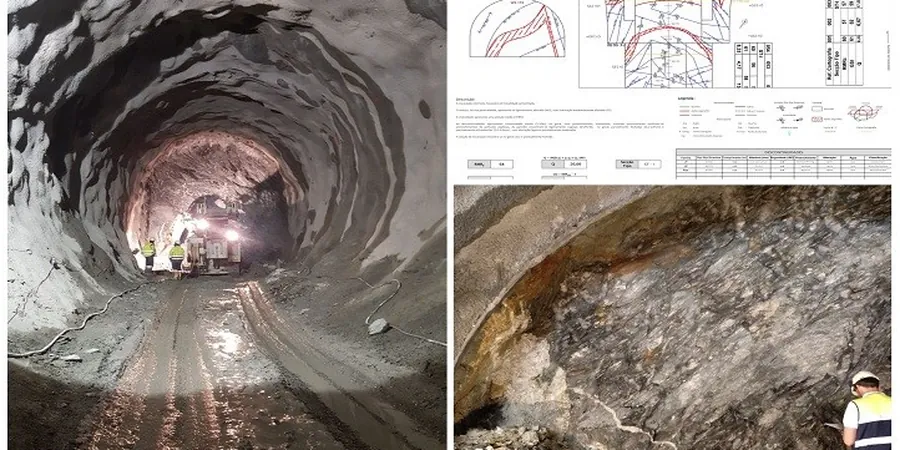
Critical ground factors in Montreal
The contrast between the Plateau Mont-Royal and Hochelaga-Maisonneuve illustrates Montreal's subsurface split. Under the Plateau, limestone bedrock sits within 4–8 meters of grade, offering a stiff tunneling medium with minimal settlement risk. Hochelaga sits on 25–40 meters of soft Champlain clay overlying till—tunnel excavation here triggers immediate ground loss unless face pressure and annular grouting are dialed in precisely. A 2014 sewer interceptor project in the east end recorded surface settlements exceeding 80 mm before compensation grouting stabilized the zone. That event reshaped how the city's engineering department approaches pre-construction monitoring. Today, every soft-ground tunnel scope in Montreal's eastern boroughs includes baseline settlement markers, piezometers at two depths, and excavation monitoring arrays installed three months before the first cutterhead rotation.
Our services
Our Montreal tunnel geotechnical scope typically includes field investigation, advanced lab testing, and numerical modeling support—customized to the alignment geology and project risk profile.
Laboratory Strength & Consolidation Testing
CU triaxial, oedometer, and constant-rate-of-strain consolidation on undisturbed Champlain clay samples to define undrained strength, OCR, and compressibility for segmental lining design.
TBM Face Pressure & Settlement Analysis
Calculation of required EPB or slurry face support pressures using wedge and chimney stability models, coupled with semi-empirical settlement trough predictions calibrated to Montreal clay behavior.
Pre-Construction Monitoring Design
Site-specific instrumentation plans including surface settlement points, multipoint borehole extensometers, and piezometer strings aligned with tunnel centerline and adjacent structures.
Frequently asked questions
What is the typical cost range for a soft ground tunnel geotechnical analysis in Montreal?
Depending on alignment length and investigation depth, a complete soft ground tunnel geotechnical scope in Montreal typically ranges from CA$5,380 to CA$20,800. That includes field vane testing, triaxial lab programs, and face pressure analysis. Final cost depends on number of boreholes, lab test count, and whether specialized tests like seismic cone or pressuremeter are required for your specific alignment.
How does Champlain clay affect tunnel excavation in Montreal?
Champlain clay is highly sensitive and loses significant strength when remolded or subjected to cyclic loading. During TBM advance, if face support pressure drops below the in-situ horizontal stress, the clay can undergo rapid volume loss leading to surface settlement. Controlling annular grout injection and maintaining consistent face pressure are critical mitigation measures.
What lab tests are needed for soft ground tunnel design?
The core suite includes consolidated-undrained triaxial tests (ASTM D4767) for undrained shear strength, oedometer consolidation tests for compressibility, and Atterberg limits for plasticity classification. We also recommend constant-rate-of-strain consolidation when faster results are needed, and field vane shear tests to capture in-situ sensitivity without sample disturbance.
How far in advance should geotechnical investigation start before tunneling?
For soft ground tunnels in Montreal, we recommend starting the geotechnical investigation at least 10–12 weeks before the planned TBM launch. This allows time for borehole drilling, undisturbed sampling, lab testing cycles, and integration of results into the face pressure and settlement models. Instrumentation installation should begin at least 8 weeks prior to excavation to capture baseline readings.