Montreal's layered urban fabric, from the stone foundations of Old Port warehouses to the deep excavations threading through the city's shale bedrock, places unique demands on earthwork quality control. The island's topography conceals a patchwork of natural soils and centuries of anthropogenic fill, which means that a specification calling for 95% Standard Proctor density is only as good as the verification behind it. In our experience, the sand cone method remains the most transparent and defensible in-place density test for granular backfill and utility trench reinstatement, precisely because the operator can see the excavated material and the calibrated sand volume with their own eyes. We combine this with proctor tests run in our accredited laboratory to establish accurate reference curves for the specific borrow source being used on your Montreal site.
A sand cone test on Montreal's glacial till can reveal compaction shortfalls that a nuclear gauge alone might mask due to mineralogical interference.
Service characteristics in Montreal
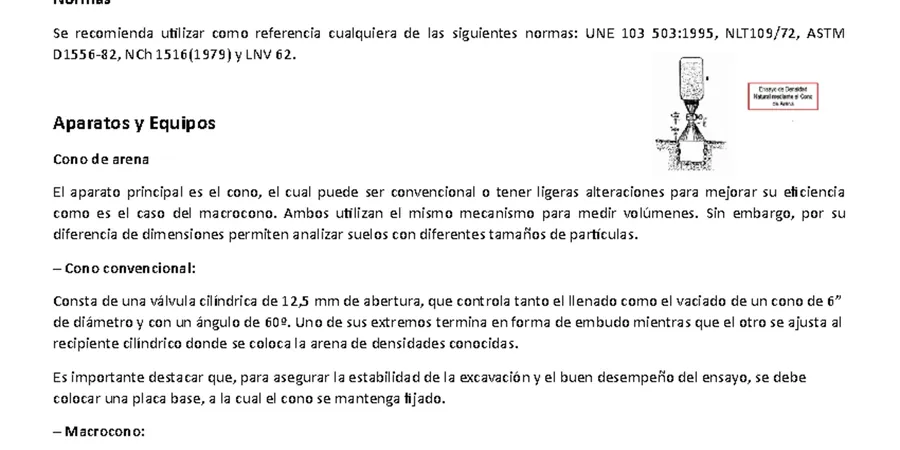
What separates a reliable result from a misleading one is attention to the base plate seal and the absence of vibration during the sand flow period. On confined urban sites in boroughs like Rosemont or Hochelaga, where a compaction roller may be working just 15 meters away, we isolate the test location and verify that the Ottawa sand's unit weight has not drifted due to humidity absorption during the shift. The method delivers a direct measurement of wet density; paired with a nuclear gauge or speedy moisture test on the excavated soil, we report dry density and percent compaction within 30 minutes of completing the hole.
Critical ground factors in Montreal
The St. Lawrence Lowlands geology beneath Montreal consists of Champlain Sea clay overlying glacial till and shale bedrock, and the clay's sensitivity to remolding is well documented among local geotechnical engineers. Compacting granular fill over a soft clay subgrade without verifying in-place density is risky because the underlying clay can deform elastically during compaction, absorbing roller energy and leaving the fill at 88–90% density while the gauge suggests 95%. We have encountered this scenario repeatedly in the eastern part of the island, where the marine clay is shallower. A sand cone test, by extracting a physical sample, reveals whether the fill has actually achieved target density or whether the subgrade is stealing the compaction effort. Another risk specific to Montreal's climate is late-season backfill placed in November or early December: frozen lumps in the fill may pass a proof-roll but produce density failures when core samples are taken the following spring. The sand cone method, executed immediately after placement, catches these problems before the asphalt goes down and the frost sets in.
Our services
Field density testing is one component of a broader compaction quality assurance program, particularly on Montreal projects where multiple fill types and variable weather demand a flexible approach. The services we provide alongside the sand cone method address the full timeline of earthwork verification.
Laboratory Proctor Compaction
Standard and Modified Proctor curves (ASTM D698, D1557) developed from representative samples of your borrow material, ensuring the field density target correlates to a realistic laboratory reference density for the specific soil being placed.
Nuclear Gauge Density Testing
Rapid in-situ density measurements using a licensed nuclear density gauge for large-area compaction monitoring, with correlation checks against sand cone results to verify gauge calibration on site-specific soils.
Grain Size Distribution
Sieve and hydrometer analysis (ASTM D422, D6913) to classify fill material and confirm that the sand cone method is the appropriate density test for the particle size range present in the lift.
Frequently asked questions
What does a sand cone density test cost on a Montreal project?
For a typical site in the Montreal region, a single sand cone density test ranges from CA$120 to CA$220, depending on the number of tests per mobilization, the travel distance to the site, and whether moisture content determination is included in the same visit. Larger programs with daily testing over multiple weeks tend to fall toward the lower end of that range.
Why use the sand cone method instead of a nuclear gauge in Montreal?
The sand cone method avoids the licensing and regulatory requirements of a nuclear gauge and is not affected by the mineralogical composition of the soil, which can skew nuclear gauge readings in some of Montreal's glacial tills and shale-derived fills. It also provides a direct volume measurement that can be verified in the field without specialized electronics.
How deep does the sand cone test hole need to be for compaction verification?
The test hole should extend through the full thickness of the compacted lift being tested, typically 150 to 200 mm for granular material placed in 200 mm loose lifts. For thicker lifts specified in some earthwork contracts, the hole depth must match the lift thickness to ensure the result represents the entire compacted layer.
Can the sand cone test be performed in wet or frozen soil conditions?
The test is not reliable in frozen ground, as ice lenses and frozen lumps distort the excavated volume and moisture content measurement. During Montreal's construction season, we schedule density testing when soil temperatures are above 4 °C and free water is not ponding in the test area; wet conditions require careful base plate sealing and faster execution to prevent sidewall collapse.