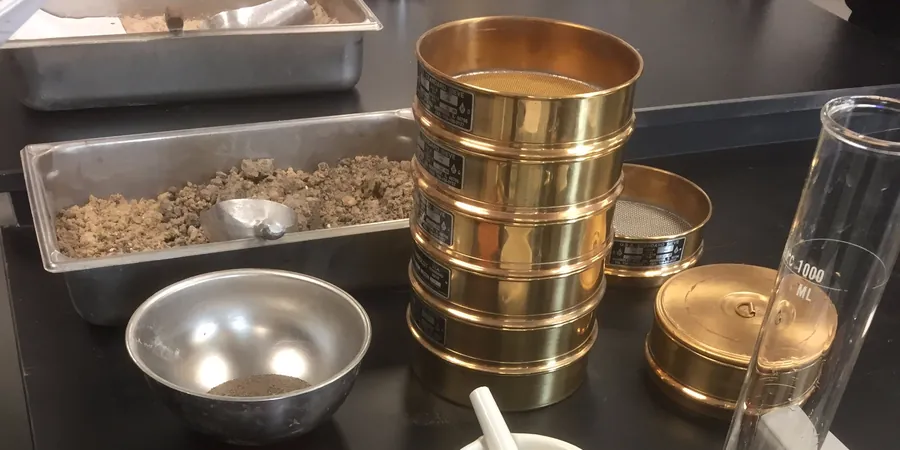
A recent excavation near the Lachine Canal uncovered a complex layer of Champlain Sea clay beneath a dense glacial till—a classic Montreal stratigraphy that demands precise classification. Grain size distribution in these soils dictates everything from drainage design to frost heave potential, especially with the city's 140+ freeze-thaw cycles per year. The combination of mechanical sieving for the coarse fraction and hydrometer sedimentation for fines below 75 µm provides the full particle-size curve that geotechnical engineers rely on for permeability estimates and liquefaction screening. In our Montreal-area projects, we often link this analysis with Atterberg limits to establish plasticity characteristics of the silty clay matrix, and with in-situ permeability testing when field hydraulic conductivity values are needed for dewatering system design.
A complete particle-size curve from 75 mm down to 2 µm is the single most useful index for predicting soil behavior in Montreal's mixed glacial and marine deposits.
Service characteristics in Montreal
Critical ground factors in Montreal
Montreal's climate imposes a unique risk factor on grain size interpretation: the severe freeze-thaw cycling that penetrates up to 1.4 m depth in exposed clay. Silts, in particular, are highly frost-susceptible, and a grain size curve showing more than 10% finer than 0.02 mm by mass can indicate potential ice lens formation beneath pavements and shallow foundations. A contractor who skips hydrometer analysis on a silty sand from the Saint-Laurent borough may miss a frost-susceptible fines content that leads to differential heave within two winters. In our experience, the hydrometer fraction also correlates with the clay mineral activity that drives the sensitivity of Champlain Sea deposits—a parameter directly relevant to slope stability assessments along the escarpments of Mount Royal and the Saint-Jacques fault zone.
Our services
We operate a dedicated soil classification laboratory serving the Greater Montreal region, from Laval to Longueuil, with standard and expedited turnaround options for grain size analysis. Each report includes the full particle-size distribution curve, calculated uniformity and curvature coefficients, and the USCS classification symbol based on the combined sieve and hydrometer data.
Combined Sieve and Hydrometer Analysis
The complete package for cohesive and mixed soils in Montreal. Covers mechanical sieving from 75 mm to 75 µm followed by hydrometer sedimentation down to the 2 µm clay fraction, with a merged gradation curve and full USCS classification.
Wash Sieve Analysis (Granular Soils)
Focused on sands and gravels typical of the Saint-Laurent lowlands, with water-washing through the No. 200 sieve to accurately determine fines content. Faster turnaround when hydrometer data is not required.
Hydrometer-Only Fine Fraction Analysis
For sensitive Champlain Sea silts and clays where the sub-75 µm distribution is critical. Includes deflocculation optimization for the specific mineralogy encountered in Montreal's post-glacial marine deposits.
Frequently asked questions
What does a combined grain size analysis cost for a project in Montreal?
For a standard combined sieve and hydrometer test in our Montreal lab, budget between CA$160 and CA$290 per sample, depending on the number of sieve sizes requested and whether expedited reporting is needed. Volume pricing applies for projects with more than ten samples.
How long does the hydrometer portion of the test take, and why can't it be rushed?
The hydrometer sedimentation phase requires readings at specific time intervals—2, 5, 15, 30, 60, 240, and 1440 minutes—following Stokes' law principles. The 24-hour reading is essential for capturing the clay fraction below 2 µm, and skipping it would compromise the accuracy of the fine-grained distribution curve that is critical for classifying Montreal's sensitive marine clays.
Is grain size analysis sufficient for classifying Champlain Sea clay, or do I need additional tests?
Grain size analysis gives you the particle distribution, but Champlain Sea clays also require Atterberg limits to determine plasticity and liquidity index, which correlate with sensitivity and remolded strength. We recommend pairing grain size with Atterberg limits and, for structured clays, occasional oedometer consolidation tests to capture the preconsolidation pressure profile.