Montreal sits on a complex quilt of Champlain Sea clays, glacial tills, and fluvial sands, much of it prone to settlement and—in a seismic zone rated NBCC 4—liquefaction. A project on Rue de la Commune recently hit loose saturated sand at just 3 meters depth. That is exactly where vibrocompaction design becomes the decisive step: we model the vibrator penetration grid, frequency, and duration so that relative density climbs above 70%, stabilizing the mass before foundations go in. The Island of Montreal’s variable stratigraphy demands more than generic charts; each design correlates CPT data with target SPT N-values per ASTM D6066, adapting to pockets of sensitive clay that standard deep vibro techniques would remold. For sites near the St. Lawrence River, we often pair the vibro program with a liquefaction analysis to confirm that post-densification factor of safety exceeds 1.3 under the design earthquake.
A well-designed vibrocompaction grid turns loose saturated sand into a stable, dense mat that adds bearing capacity and eliminates liquefaction risk in one operation.
Service characteristics in Montreal
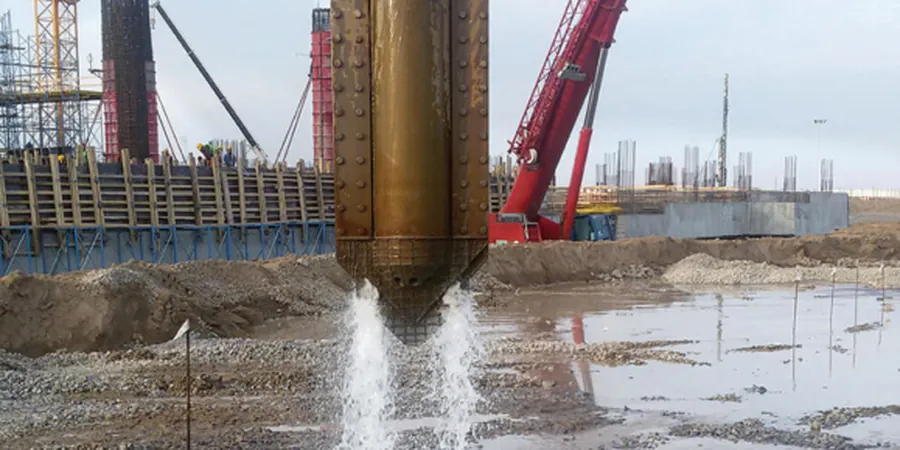
Critical ground factors in Montreal
The most expensive mistake we see in Montreal is skipping the pre-design CPT campaign and assuming a uniform sand profile. Loose alluvial pockets interbedded with silty lenses react very differently to vibration: the energy dissipates instead of densifying, and the contractor burns hours of rig time with zero improvement. Another common error is placing the vibroflot grid too wide, leaving untreated columns between probes that later become preferential drainage paths or settlement zones. Our design phase catches these risks early: we map the spatial variability along the Saint Lawrence lowlands, adjust spacing in real time when the bottom-feed system hits a change in resistance, and require a test panel before production runs. In a city where winter frost penetrates 1.5 meters and spring thaw saturates the upper crust, incomplete densification leads to differential heave and cracked slabs within two seasons.
Our services
Our Montreal vibrocompaction scope covers everything from the numerical model to on-site verification, always aligned with the National Building Code of Canada and CSA A23.3 requirements for soil-structure interaction.
Grid Design and Energy Calibration
We determine probe spacing, vibrator power (130–180 kW), and water/air flush pressure based on grain-size curves from Montreal’s fluvio-glacial deposits. The target is a consistent relative density of 70–85% across the treatment zone.
Liquefaction Mitigation Modeling
Using CPT and SPT data, we run cyclic resistance ratio calculations per Youd-Idriss (2001) to size the improvement depth—often 8 to 14 meters in downtown Montreal—ensuring post-treatment CSR < CRR under the 2% in 50-year seismic event.
Settlement Control for Fill and Loose Sand
For warehouse pads in Anjou or logistics hubs in Saint-Laurent, we design densification to limit total and differential settlement under 25 mm, verified by pre- and post-compaction CPT soundings at the same coordinates.
Quality Assurance and Instrumentation
We deploy real-time monitoring on the vibroflot: depth, amperage, and penetration rate. Post-treatment verification includes SPT, CPT, and occasionally crosshole seismic to confirm shear wave velocity improvement.
Frequently asked questions
How much does vibrocompaction design cost for a typical Montreal site?
For a standalone vibrocompaction design—grid layout, energy calibration, and verification protocol—the fee ranges from CA$2,180 to CA$6,550, depending on treatment area, depth, and the number of CPT soundings required. A 1,000 m² site with 10-meter treatment depth usually sits near the middle of that range.
Does vibrocompaction work in Montreal's Champlain Sea clay?
No. Vibrocompaction is effective in cohesionless soils—sands and gravels. Montreal’s Champlain Sea clays are sensitive and do not densify under vibration. In those zones we recommend stone columns or rigid inclusions instead. Our design always starts with a stratigraphic review to avoid applying vibration where it would remold sensitive clay and worsen settlement.
How deep can vibrocompaction improve the ground?
In Montreal’s fluvio-glacial deposits, we routinely design treatments to 12–14 meters. The practical limit depends on vibrator power and soil resistance; below 15 meters, alternative methods like deep soil mixing become more economical.
What post-treatment verification do you require?
We specify CPT soundings at the centroid of each compaction grid cell, compared directly to pre-treatment baselines. For critical structures, we add SPT borings and occasionally crosshole shear wave velocity profiles to confirm the stiffness increase.