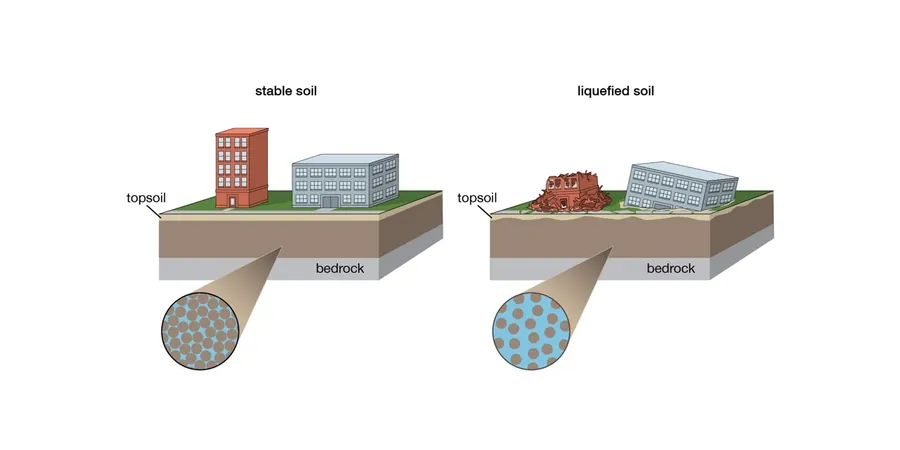
A split-spoon sampler drives into the Champlain Sea clay with a hollow thud, and the blow count tells a story. That story is about pore pressure and grain arrangement. In Montreal, the seismic hazard is real—the Western Quebec Seismic Zone has produced magnitude 5+ events, and the 1732 earthquake near the Island of Montreal rattled stone buildings for hundreds of kilometers. A standard penetration test alone is not enough. We run the numbers through simplified procedures, checking cyclic stress ratios against cyclic resistance ratios at every critical layer. When silt-rich deposits show borderline behavior, we pull undisturbed Shelby tubes and send them to the lab for cyclic triaxial testing. The goal is not to declare a site safe; it is to quantify how much excess pore pressure builds up and what that means for bearing capacity and settlement.
Liquefaction is not a yes-or-no question; it is a calculation of how much pore pressure builds up and how much settlement that leaves behind.
Service characteristics in Montreal
Critical ground factors in Montreal
The 1988 Saguenay earthquake, a M 5.9 event 350 km north of Montreal, reminded everyone that the Canadian Shield is not seismically quiet. Montreal sits on the edge of the shield, atop soft post-glacial sediments that amplify ground motion. The Champlain Sea clays can be sensitive, and the scattered lenses of silty sand within them are the layers that worry us. Liquefaction here tends to be localized, not basin-wide, but that makes it harder to predict with regional maps. A site-specific analysis is the only reliable path. If a thin liquefiable lens sits directly beneath a footing, even 15 mm of differential settlement can crack structural slabs and sever utility connections. In our experience, the biggest cost driver is not the analysis itself; it is discovering the problem after the structural design is locked in.
Our services
A liquefaction study in Montreal rarely stands alone. It sits inside a broader geotechnical investigation. The services below are the typical building blocks we assemble to produce a defensible factor of safety and a practical mitigation strategy.
Cyclic Stress Ratio Profiling
We compute CSR from site-specific ground motion, corrected for overburden and magnitude, at every sample depth. The profile identifies which layers cross the liquefaction threshold and by how much.
Post-Liquefaction Settlement Analysis
Using Tokimatsu & Seed and Ishihara & Yoshimine methods, we estimate volumetric strain as a function of factor of safety and relative density, translating it to surface settlement.
Lateral Spreading Hazard Assessment
For sites adjacent to the Saint Lawrence River or its former channels, we evaluate lateral displacement potential using empirical models calibrated to the local slope geometry.
Ground Improvement Verification
After treatment—whether vibrocompaction, stone columns, or deep soil mixing—we run pre- and post-treatment CPT or Vs profiles to confirm the target factor of safety is achieved.
Frequently asked questions
Is liquefaction really a concern in Montreal, given the low historical seismicity?
Yes. While Montreal's seismicity is lower than the West Coast's, the Western Quebec Seismic Zone is active and capable of M 6.5+ events. The soft Champlain Sea sediments amplify shaking, and scattered sand lenses within the clay are susceptible to liquefaction under the right conditions. The NBCC 2020 includes Montreal in a moderate seismic hazard zone, and site-specific analysis is required for critical and post-disaster buildings.
What is the typical cost range for a liquefaction analysis in the Montreal area?
A complete liquefaction study, including field investigation (boreholes with SPT or CPT soundings), laboratory testing, and the engineering report, typically ranges from CA$3.130 to CA$6.010 depending on the number of test points and the complexity of the stratigraphy. Sites requiring cyclic triaxial testing on undisturbed samples will be at the upper end.
How deep do you investigate for liquefaction potential?
We follow NBCC and NCEER guidelines, which generally require investigation to a depth where the overburden stress or soil density makes liquefaction unlikely. In Montreal, this is typically 20 to 25 meters below grade, but we adjust based on the CPT refusal depth and the presence of dense till or bedrock. The key is to capture any loose sand or silt layer within the zone of influence.
Can you use existing borehole logs, or do we need new fieldwork?
Existing logs can provide a preliminary screening, but for a defensible factor of safety, we almost always recommend new fieldwork. SPT data from old reports often lack the required hammer energy calibration, and CPT soundings—which give a continuous profile—are far superior for detecting thin liquefiable seams that a split-spoon sampler might miss every 1.5 meters. More info.