Geotechnical laboratory testing in Montreal provides the physical characterization of soils and bedrock that underpin safe, durable designs across the region. The city’s Champlain Sea clays, glacial tills, and sensitive silts demand precise index and classification data to anticipate volume change, frost susceptibility, and consolidation behavior. Routine programs begin with Atterberg limits to define plasticity and liquidity indices, then pair those results with a full grain size analysis (sieve and hydrometer) in accordance with CAN/BNQ 2501 and ASTM D6913/D7928. Together, these tests establish the Unified Soil Classification and feed directly into bearing capacity and settlement models calibrated for Quebec’s post-glacial deposits.
These laboratory programs are mandatory for deep excavations in the downtown core, infrastructure corridors such as the REM, and residential foundations on the island’s compressible clay plains. Complementing index tests, our Montreal facility runs consolidation, triaxial, and chemical analyses to meet the requirements of the *Code de construction du Québec* and CSA standards. When grain-size distributions reveal gap-graded or frost-susceptible materials, the data guide drainage design and thermal protection strategies. The same Atterberg limits and grain size analysis support slope stability back-analyses and embankment quality control, ensuring every project phase—from feasibility to construction—rests on verified, repeatable soil parameters.
Montreal's stiff fissured clay crust can double the bond capacity of a passive anchor—if you respect the drainage boundary at the excavation face.
Service characteristics in Montreal
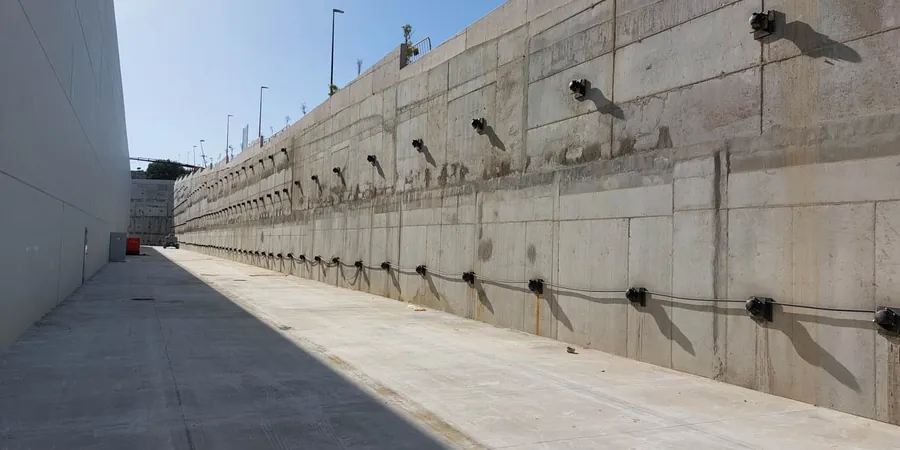
Critical ground factors in Montreal
Montreal sits at only 7 meters above sea level in the low-lying Centre-Sud, but the true risk for anchor design comes from the 5.8 magnitude Charlevoix seismic zone that influences the entire St. Lawrence corridor. NBCC spectral accelerations for a 2% in 50-year event can exceed 0.6g on soft soil sites, turning a routine tieback wall into a structure that must resist cyclic degradation of the grout-soil interface. Seismic-induced pore pressure build-up in the Champlain Sea clay can reduce effective stress at the bond zone, a mechanism that has been documented in post-earthquake reconnaissance in similar eastern Canadian clays. Our designs account for this by limiting the mobilized bond stress to a fraction of the peak value and specifying sacrificial anode protection where groundwater chemistry, often saline in pockets near the port, accelerates corrosion.
Our services
Anchor design in Montreal requires more than a pull-out capacity check. The interaction between the anchor, the wall system, and the retained soil mass must be understood as a single mechanism. The following services form the core of our local practice.
Permanent tieback anchors
For basement excavations and infrastructure cuts where the anchor remains in service for the life of the structure. Design includes double-corrosion protection and isolation of the free length from the bonded zone, tested to 133% of the design lock-off load.
Temporary passive anchors
Cost-effective solution for staged open-cut excavations in the Montreal area. Passive bars develop resistance through soil deformation ahead of the failure plane; we pair this with inclinometer monitoring to confirm that movements stay within the limits agreed with adjacent property owners.
Frequently asked questions
What is the difference between an active and a passive anchor?
An active anchor is tensioned against the structure immediately after installation—it applies a pre-compression to the soil or rock mass and controls wall deflection from the start. A passive anchor only develops its resisting force once the soil begins to move and deform the anchor. In Montreal excavations, we typically use active anchors for permanent basement walls where millimetres of movement matter, and passive anchors for temporary cuts where some relaxation is acceptable.
How do you determine the bond length in Montreal's Champlain clay?
Bond length is estimated from the undrained shear strength profile obtained via in-situ testing, typically CPT or field vane. We apply a reduction factor to account for fissuring and post-peak strength loss, then confirm the estimate with on-site pull-out tests on sacrificial anchors before production drilling begins. The stiff crust layer often allows shorter bond lengths than the underlying soft clay.
What is the typical cost range for an anchor design and testing package?
For a complete package covering geotechnical investigation review, load-transfer analysis, anchor layout, and on-site proof testing supervision, projects in the Montreal region generally range from CA$1,400 to CA$5,110 depending on the number of anchors and the complexity of the soil profile.