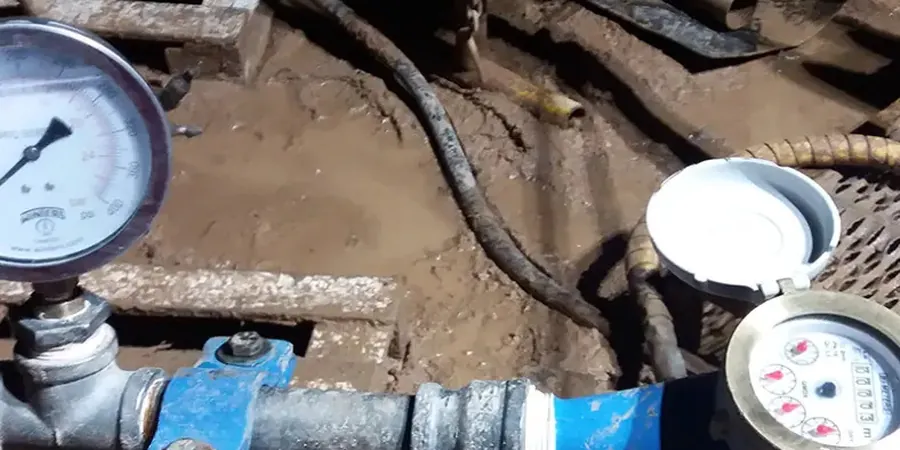
The Lefranc and Lugeon packer systems are lowered into a completed borehole, sealing off a test section with pneumatic inflatable bladders. In Montreal, where the limestone and shale of the Trenton Group are often fractured by glacial scouring, the Lugeon assembly delivers pressurized water in five-step sequences while a digital flowmeter captures the exact volume escaping into discontinuities. The Lefranc variant, operated in granular overburden across the St. Lawrence Lowlands, uses a constant or falling head within a screened casing segment, recording the rate of dissipation through sandy till or Champlain Sea silts. Both methods feed data directly into the in-situ permeability calculations required for dewatering design and basement drainage assessments.
A five-step Lugeon sequence in fractured Trenton limestone reveals not just permeability, but the critical pressure at which fracture dilation begins.
Service characteristics in Montreal
Critical ground factors in Montreal
A 25-storey mixed-use tower near the Peel Basin required a 14 m deep excavation into limestone with a high water table just 3 m below street level. The contractor installed a single packer at 18 m depth and applied a maximum pressure of 5 bar; the flow rate jumped abruptly at step three, confirming fracture interconnection with the Lachine Canal. Without that real-time P-Q curve, the dewatering array would have been undersized by at least 40%, risking basal heave in the open cut. In Montreal's densely built Griffintown corridor, an undetected permeable joint set can flood a foundation pit within hours, and the cost of emergency pumping plus adjacent settlement damage far exceeds the investment in a properly executed packer test program.
Our services
The field team deploys two configurations adapted to Montreal subsurface conditions, each with specific instrumentation and analysis workflows.
Lugeon Packer Testing in Rock
Designed for the Trenton Group limestone and Utica shale, this method uses a double-packer assembly isolating 1 to 5 m sections. Five pressure stages are maintained for ten minutes each, with flow and pressure digitized simultaneously. The resulting Lugeon value and P-Q curve identify fracture flow regimes, dilation thresholds, and the effective hydraulic aperture. Reports include step-test graphs, transmissivity per interval, and recommendations for grouting cutoff depths.
Lefranc Variable-Head Testing in Overburden
Applied in granular till, Champlain Sea clays, and sandy lenses above bedrock. A screened casing section is isolated and filled with water; the rate of head decay is recorded with a submersible pressure transducer at 1-second intervals. Analysis follows Hvorslev's equations for point-source geometry, corrected for wellbore storage. Data sheets deliver k values per test horizon, essential for sheet pile design and temporary excavation dewatering plans.
Frequently asked questions
What is the difference between a Lefranc and a Lugeon permeability test?
A Lefranc test measures hydraulic conductivity in soil or very soft rock using a constant or falling head within a short screened section, following Hvorslev analysis for a point piezometer geometry. A Lugeon test specifically targets fractured rock, applying water under pressure through a packer-sealed interval in five incremental steps to evaluate the relationship between pressure and flow, including fracture dilation and infill washout effects.
How long does a typical packer test take on a Montreal drill site?
A single-interval Lugeon test with five pressure steps typically requires 90 to 120 minutes of active testing after borehole preparation, plus additional time for water level recovery monitoring. For a Lefranc falling-head test in silty till, the dissipation curve may stabilize within 30 to 60 minutes depending on the hydraulic conductivity of the formation.
What is the approximate cost of a field permeability test in Montreal?
The typical budget for a packer permeability program in the Montreal region, including mobilization, single or double packer setup, data acquisition, and engineering interpretation, ranges from CA$770 to CA$1,280 per test interval depending on depth, access conditions, and the number of zones tested.