Montreal's pavement infrastructure endures roughly 210 freeze-thaw cycles annually, a thermal stress regime that degrades subgrade strength faster than in most Canadian cities. The laboratory CBR test quantifies that remaining bearing capacity under controlled moisture and density conditions, delivering numbers that design engineers can trust. Our team runs soaked CBR specimens for four days at constant head, simulating the worst-case spring thaw scenario when the water table peaks and granular bases lose confinement. With the city's dense glacial till and pockets of Champlain Sea clay, a single CBR value can shift pavement thickness by 90 mm. We prepare remolded samples at 95% of Modified Proctor maximum dry density, following ASTM D1883-21 and AASHTO T-193, and report both the corrected CBR at 2.54 mm and 5.08 mm penetration. For jobs near the Lachine Canal or on the island's eastern industrial flats, the test also flags moisture sensitivity that would otherwise show up as alligator cracking within two seasons. Complementing the CBR, a field density check verifies that the compacted lift actually meets the target before surfacing crews move in.
A one-point drop in laboratory CBR can add 40 mm of granular base to a Montreal arterial road, multiplying aggregate costs across the full lane-kilometer.
Service characteristics in Montreal
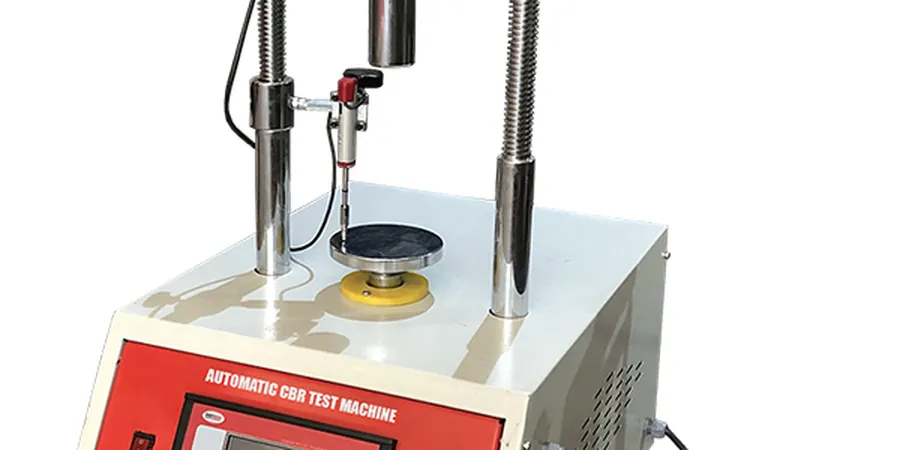
The lab maintains temperature-controlled curing rooms that hold 22 ± 2 °C and relative humidity above 95 percent throughout the soak. Load readings are taken at 0.64 mm intervals up to 7.62 mm penetration, and the stress-penetration curve is corrected for surface irregularities using the zero-point adjustment specified in ASTM D1883. For projects following MTQ (Ministère des Transports du Québec) standards, we also tabulate the CBR at 95 percent modified Proctor and at natural moisture content, giving the pavement engineer both a design value and a construction control benchmark.
Critical ground factors in Montreal
The most common mistake we see on Montreal road projects is accepting a single CBR value from a borrow source without testing the actual compacted subgrade after trimming. Gravel from the Saint-Eustache quarries can post a CBR above 50 in the lab, but if the underlying silty clay of the Champlain Sea deposits is left untreated and the top 300 mm remolds during grading, the composite bearing ratio at formation level may drop below 3. That mismatch goes undetected until the first heavy rain, when rutting appears under bus lanes. Another recurring failure involves ignoring the swell component: a soaked CBR of 8 with zero swell behaves differently from a soaked CBR of 8 with 4 percent swell, because the latter indicates a volume change potential that will lift the pavement and open cracks at the curb line. Montreal's borough engineering departments now routinely require both the CBR curve and the swell-time plot in the geotechnical report, and our lab formats the data exactly to those submission requirements, including the MTQ coefficient of curvature for the corrected stress-penetration graph.
Our services
The laboratory CBR test anchors a broader pavement evaluation workflow. These two services address the most frequent requests from Montreal's civil contractors and consulting firms:
Soaked CBR with Swell Monitoring
Full ASTM D1883 procedure with 96-hour soak, continuous swell measurement, and corrected stress-penetration curves. We test remolded specimens at target moisture and density, plus a duplicate at natural water content when field conditions are uncertain. Report includes the CBR at 2.54 mm and 5.08 mm, swell percentage, dry density, and moisture content.
Combined CBR and Proctor Package
Modified Proctor (ASTM D1557) to establish the moisture-density relationship, followed by three CBR specimens compacted at optimum, optimum +1%, and optimum -1%. This bracketed approach gives the pavement designer a sensitivity envelope, showing how CBR changes with compaction moisture. Particularly useful for silty subgrades encountered in Montreal's east-end boroughs.
Frequently asked questions
How much does a laboratory CBR test cost in Montreal?
A single-point laboratory CBR test with 96-hour soak runs between CA$190 and CA$300, depending on whether the client supplies the bulk sample and the target Proctor data or we prepare everything from scratch. A bracketed set (three moisture points) falls in the CA$440 to CA$550 range. Expedited turnaround is available for an additional surcharge.
How long does the CBR test take from sample receipt to report?
Standard turnaround is five to six business days: one day for sample preparation and compaction, four days for the soak, and one day for penetration testing, data reduction, and QA review. Projects on tight schedules can request a three-day expedited service, but the 96-hour soak period cannot be shortened without compromising the engineering basis of the result.
What sample size do you need for the laboratory CBR test?
We require approximately 25 kg of representative material passing the 19 mm sieve for a single-point CBR, or 60 kg for a three-point bracketed series. The sample must be sealed in an airtight bag immediately after field collection to preserve natural moisture. For Montreal sites with cobble-rich till, field scalping to remove particles larger than 19 mm is acceptable, but the scalping percentage must be recorded on the chain of custody.