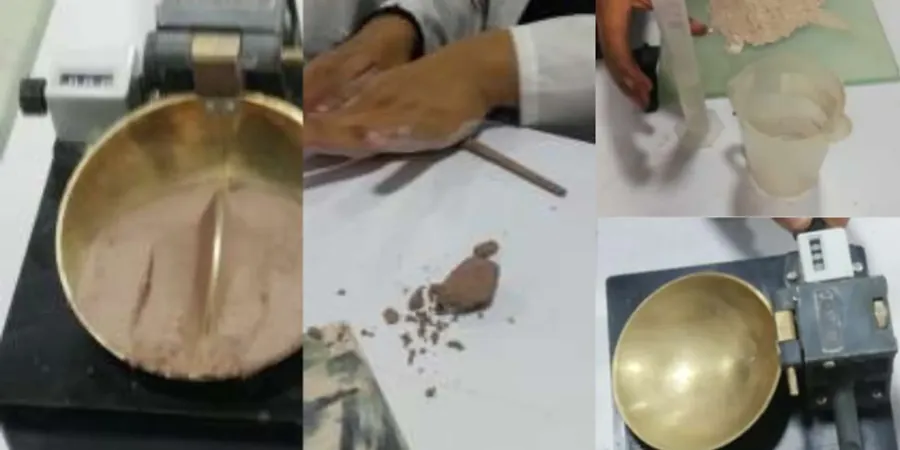
We still see contractors in Montreal skip Atterberg limits on a tight budget, only to watch their excavation slump after a single rainstorm. The problem is never the clay itself. It is the assumption that all fine-grained soils behave the same way. Montreal sits on the Champlain Sea basin, a post-glacial deposit where silty clays can transition from brittle solid to viscous liquid with very little water. Understanding that transition requires the liquid limit, plastic limit, and shrinkage limit. ASTM D4318 gives us the framework. Our lab runs the full set on every sample from the Plateau to Lachine, because plasticity data determines whether a trench needs shoring, whether a footing will experience differential heave, and whether a slope can hold during spring thaw. For deep excavations in Old Montreal, we often combine Atterberg testing with a slope stability analysis to anchor the numerical model in real index properties instead of textbook defaults.
A liquidity index above 1.0 means your excavation is not cutting a solid. It is containing a viscous fluid with a thin weathered crust.
Service characteristics in Montreal
Critical ground factors in Montreal
NBCC 2015 references geotechnical investigation requirements that include index testing for fine-grained soils, and CSA A23.3 expects foundation recommendations to account for volume-change potential. In Montreal, ignoring Atterberg limits on Champlain clay is not just a code deviation. It is a direct path to heave in shallow footings and loss of passive resistance in cantilever walls. The sensitivity of these clays, often between 10 and 50, means that remolding during auger drilling or pile installation can destroy the undisturbed shear strength. We use the liquidity index as a quick field indicator. If LI exceeds 0.8, we flag the soil as highly sensitive and recommend undisturbed sampling with thin-wall Shelby tubes instead of relying solely on SPT blow counts. The plastic limit also controls the transition from semi-solid to plastic behavior, which is the moisture range where frost heave becomes most aggressive. A soil that stays plastic all winter will heave more than one that shrinks into the semi-solid state early in the freeze cycle.
Our services
Atterberg testing is rarely the full story. We pair it with complementary lab and field services to build a complete geotechnical model for your Montreal project.
Grain Size Distribution by Sieve and Hydrometer
Full ASTM D422/D6913 analysis to quantify the clay fraction needed for activity calculation and USCS classification. We run the hydrometer on the same sample after Atterberg limits are complete.
One-Dimensional Consolidation (Oedometer)
ASTM D2435 consolidation testing on undisturbed Champlain clay samples. The compression index and preconsolidation pressure, combined with Atterberg data, give a reliable estimate of settlement magnitude and rate.
Unconsolidated Undrained (UU) Triaxial
ASTM D2850 UU triaxial on sensitive clays at natural moisture content. We correlate undrained shear strength with liquidity index to validate field vane data and assess sample disturbance.
Frequently asked questions
What is the cost range for Atterberg limits testing in Montreal?
For a standard set including liquid limit, plastic limit, and plasticity index, expect to pay between CA$80 and CA$130 per sample. The price depends on whether you need the shrinkage limit as well and how many points are required for the liquid limit curve. Rush turnaround adds a surcharge, but we can typically deliver results within 48 hours for routine projects.
How many samples do I need for a typical Montreal residential foundation investigation?
We recommend at least one Atterberg test per distinct soil layer encountered in the borehole or test pit. For a two-story residential structure on Champlain clay, that usually means three samples: one from the weathered crust, one from the intact clay at footing depth, and one from the deeper bearing stratum if the clay extends beyond 3 meters.
Can you run Atterberg limits on samples that have been frozen during winter drilling?
Yes, but we need to know they were frozen. Freeze-thaw remolding changes the liquid limit. We note the sample history on the report and, if the values look anomalously low, we request a re-sample from below the frost penetration depth, which in Montreal can reach 1.5 meters in an open lot with no snow cover.
What is the difference between the liquidity index and the consistency index?
The liquidity index indicates where the natural water content sits relative to the plastic and liquid limits. A value near zero means the soil is at the plastic limit. A value near one means it is at the liquid limit. The consistency index is simply 1 minus the liquidity index. We report both because the consistency index maps more intuitively to undrained shear strength correlations for Champlain clay.
Do you perform Atterberg limits testing for contaminated or organic soils?
Yes. For organic silts and clays from the former industrial corridors near the Lachine Canal, we run the liquid limit on both oven-dried and air-dried specimens. Organic matter oxidizes during oven drying and can lower the liquid limit by 10 to 15 points. We flag the difference in the report so the design team does not underestimate plasticity and shrink-swell potential.